Welcome to BizBytes

Enjoy tips and strategies to improve your business, advance your career, or just have a chuckle at the funnier side of office life. We welcome your input -- share your stories with us! Follow us:
Twitter @merylecorbett
Facebook Meryle Bizcoachonline
website http://www.bizcoachonline.ca/
email meryle@bizcoachonline.ca

Showing posts with label supervising. Show all posts

Tuesday, March 22, 2011

Performance Discipline - 7 tips for Winning Results

Managing people is usually the difficult part of a job - human interaction leaves much open to interpretation.  When an employee is not performing, there are many variables that contribute to the problem:
   - personal issues (these can cloud an empoyee's judgement or capability)
  - unclear expectations (ever try to do a job when you aren't sure WHAT to the job is?)
  - lack of job training (impacts capability)

The key question to ask:  "Is this employee trainable / salvagable to eventually perform the required job?" 
When your answer is "yes", the solution is usually added training or clarified expectations.  When your answer is "no", it's time for employee performance discipline.  Okay, so it's time for discipline.  Some hints:
.
1)  Determine the specific expectations required on the job
Make sure there is a clear, written job description (this is the minimum performance delivery required for the employee to keep his/her job).  Review expectations with the employee - use examples to clarify how the job duties are to be performed or delivered.
.
2)  Work with the employee to establish agreed upon standards for performance. 
These standards may include timeliness (ie. meeting deadlines), accuracy or quality levels, and completeness of job duties.  Often, employees, when asked what is a reasonable job standard, will commit to a higher level than the supervisor expects.  Make sure there are clear measures of these agreed standards so that the employee can self-monitor results and report back on a regular basis.
.
3)  Follow up daily, weekly or monthly on measurement of standards. 
Frequency of meeting will depend on the degree of supervision appropriate to the situation.  Where results are below standard, identify solutions that both employer and employee can participate in (i.e. job-specific training by employer, self-study or extra care by employee)
.

4)  When continued efforts to improve performance are not successful, written discipline is the next step. 
Before meeting, write down a specific list of performance deficiencies including specific examples of each deficiency.  When you are ready for the discipline meeting, keep this list handy and quietly (subtly) "tick off" each item on the list as you discuss with the employee.  This list will help keep you on track, ensure you don't forget anything and will also become your HR documentation if needed later.
.

5)  Buy a box of tissues 
Keep them handy in case the employer/employee meeting becomes emotional.  If the employee cries, hand out the tissue(s) and wait......   resume the meeting and complete discussion of the deficiencies when the employee is composed.  


If you cancel the rest of the meeting once crying commences, you will have to redo the discipline discussion all over again at a later time -- it's better to complete all of the issues in one meeting and get the pain over with. 
.

6)  Conclude the meeting with a solution and action plan with dates for followup. 
This is usually a list of performance standards to remain employed (stated to the employee in a letter).  
.

7)  Have a Plan B in the back of your mind, in case an employee is beligerent or insubordinate. 
There will be situations where an employee will never admit performance problems or who, by the end of the meeting, you will realize they are "unsalvageable" in terms of ever getting to required performance levels.  In these more severe cases, having a more serious discussion about termination or resignation can be appropriate.  You may also keep a termination letter handy (with researched severance options etc), to be presented only in a worst case scenario - this can save you the difficulty of rescheduling a separate termination meeting later. 
.
Where possible, work on training, clear expectations and ways to salvage employees - this is the mark of true leadership!

Monday, March 21, 2011

Leading Quietly - guest post by Jim Estill

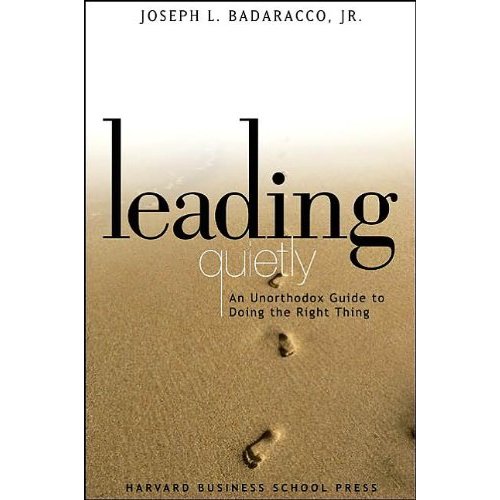
One of the books I read on the weekend was – Leading Quietly – An unorthodox Guide to Doing the Right Thing by Joseph Badaracco. 


The book is more about the subtitle “An unorthodox Guide to Doing the Right Thing” than the title – “Leading Quietly”. It did make a valid point that often the best leaders are not the loud stars that the press talks about all the time. Often the best leaders are the quiet plodders that create value over a long period of time.
Much of the book talked about making decisions in uncertain circumstances. Much of leadership involves decision making. And most decisions are not clear. The mark of a good leader is one who is willing to make the decisions quickly. Good leaders know when enough information is enough (some people will not make decisions because they want more information even though the probability of that information changing the decision is negligible). As Badaracco says “the courage to prudently tackle tough situations”.

Good leaders do not balk at making decisions even though there is risk involved. Usually there is greater risk in not making the decision.

Much of good decision making is about identifying the problem and simplifying it. Einstein said “Everything should be as simple as possible and no simpler”.

On statement that rang true to me “leadership is hard work”. I guess I never really thought about it but at the time I was reading it, I was struggling with many issues and juggling many balls so it hit home. It also talked about tenacity. This is a trait that I try hard to have. When I do not get the answer I want, I try to figure other approaches to make the sale (and most things are sales even if they involve selling internally or selling someone in a negotiation).

Good book.
Posted by Jim Estill http://www.jimestill.com/

Thursday, March 17, 2011

How to make progress - even when overwhelmed with stress

"You eat the elephant one bite at a time" -- sounds a bit yucky, eating elephants, but that saying has been a strategy to maintain solid progress at work during times of crazy overload and stress.

When there are 15 projects going on simultaneously, hundreds of emails and calls piled up (unanswered) and a constant lineup of people in the office doorway (where's the "take a number" system when you need it!?) it's easy to want to shrivel up and crawl under the floor.  Progress seems overwhelming and impossible!

How to make real progress, then?

1)  Pick one task that is relatively easy to accomplish and JUST DO IT.  It doesn't matter how small the task is, doing something is progress.  Progress, however small, is success.  

2)  Once you have gained momentum by finishing one task, pick another one and JUST DO IT again.... and again.   After many tiny steps, you will eventually see noticeable progress. 

3)  Break very large projects down into smaller steps.  Create several "milestones" or mini-accomplishments, maybe 5 to 10 of them.   Then put milestones in sequential order and start working on the first one.  Viewing big projects in smaller chunks makes them seem more feasible and less overwhelming. 

4)  If you are still feeling overwhelmed, try offloading strategies:
          - delegate smaller parts of the job to others
          - create a list and sort into A, B, C priority (always do A priorities first)
          - apply the 30-second rule:  if you can finish something in 30 seconds, JUST DO IT

5)  Find and maintain support systems:
          - utilize a work buddy where you can ask for help or with whom you can bounce ideas around,
          - find someone to help review/reprioritize your total workload strategically at the "50,000 foot level"
          - exercise regularly (walk, run, do yoga, play sports) to offload the mental stress

Progress will come in waves -- it will seem like nothing happens for days or weeks, but you may be surprised at the traction and progress when you look back over a period of time.  


Don't forget what you have already accomplished -- shift your expectations to smaller chunks of achievement, and you will be more positively motivated toward future success! 


Monday, March 14, 2011

5 Key Ingredients for Success -- in Sports and Business

The following tips come from a sports coach at Shelby High School in Montana, Ray Wanty.  Ray distilled his learning and coaching of successful athletes into 5 key elements.  I think these 5 key elements apply equally to business, and even to overall personal success.  Consider them and see if you agree:

The Level of  Our Success is Dependent on…

1. The Daily Habits We Create
     - am I creating good habits? 
     - am I getting rid of bad habits?
     - do I add new habits regularly that keep me growing and developing?
     ... my daily habits become the core expression of who I am

2. Our Most Dominant Thoughts
     - my thoughts drive my feelings, which drive my behavior
     - positive thoughts will keep me upbeat
     - I need to control and focus the "channels" in my brain
     ... my thoughts eventually become my beliefs and my behavior and my destiny

3. How Well We Serve Others
     - my interaction with others builds my own network and support system
     - my service to others builds my esteem and credibility
     ... my behavior in my community establishes my reputation and esteem

4. The Amount of Sincere Gratitude You Show
     - my sincerity and gratitude provide opportunity for leadership
     - my sincerity and gratitude allow me to fully enjoy my successes
     ... my sincerity and gratitude will build and strengthen my relationships

5. The Level of Commitment Towards Your Passion (Singleness of Purpose)
     - Commitment to my passion helps me remain focused on the end goal
     - Commitment to my passion heps me fend of distractions
     - Commitment to my passion increases my speed of success
     ... Commitment and Singleness of Purpose is the ingredient that links my thoughts, behaviors, support systems and relationships together to attain success

Friday, March 11, 2011

"Can't" is a four letter word! 4 Tips to break through barriers....

High performance racecar drivers and pilots overcome obstacle courses with an interesting technique. They visualize the "path around" any obstacle or barrier in their way.  

One professional pilot described the risks very succinctly:  "If you look at the barrier, you will most likely hit it.  If you look at the path around the barrier, you will be successful and maintain your momentum."

How often do we focus on the negative barriers or obstacles in our own work or personal situations?  

- I have watched teams implode because polarized groups took sides; each focused on negative aspects of the other position. 

- I have watched marriages falter because one or both parties focused on the negatives and irritations of the other partner. 

- I have watched business ventures fail because partners lost trust in each other and each "dug in" to a position that they could not work through to a resolution.


The secret?  Creative thinking, using "outside the box" analysis with the goal of creating a unified "new approach" to an agreed upon end solution.  

Ha!  Easy to say, but how does one actually accomplish this?
1) Agree on a common vision or end result; get everyone on the same page.   Restating your end result as a "vision statement" can be helpful:


2) Use  creative thinking techniques to brainstorm alternative solutions (remember: ignore the barriers and negatives, focus only on new, innovative alternatives) 


3) Filter your list of brainstormed alternatives into an agreed ranking of highest to lowest priority.  If necessary, you may have to agree first on the criteria to be applied to  calculate the ranking.  For example, must be a) within current budget, b) feasible with  existing staff resources, c) leaves no department at a significant market disadvantage, etc.

4) Remember the "people" side of these issues -- rebuild trust between polarized groups.  A great book that I have used is The Speed of Trust by Steven M. R. Covey. 


If you can break out of the downward spiral of negative emotion, you have a good chance of eliminating that 4-letter word, "can't" from the vocabulary of your business.  

It's all about focus  -- concentrate on the end vision to drive your success!

Wednesday, March 9, 2011

Leaders Cannot Be Blamers: 3 Things - guest post by QAspire


The true test of a leader is when things don’t go as planned. Worst yet, when things fail.

In an organizational context, I have seen so many leaders who drive the project/initiative right from the beginning – yet when the project fails, they blame others. They blame senior management, the organization culture, their own team members and sometimes even the customers. It tells me something – if you decide that you want to blame “others”, you will invariably find those “others”. That is an easy choice, and the one that puts everyone down.
When leaders indulge into the blame game, they lose respect because they throw a negative vibe around. This vibe is powerful (and sometimes even viral), because it comes from someone who is supposed to be a leader. It spreads fast, harms reputation of leader and culture of the organization on a longer run.

If you are a leader at any level, here are three things worth noting:
  • Blaming is easy but taking responsibility, learning from mistakes and implementing those lessons to improve constantly is difficult. It is these difficult things that makes a real leader. Similarly, for an organization, building a culture where people are not afraid of taking responsibility is critical.
  • Leaders need to watch and choose their words. Every conversation with others is an opportunity to make a difference. When you talk negative, focus too much on problems and blame others, you are missing the opportunity.
  • Leadership is about using “we” language more than “I versus them”, and that kind of leadership owns the failures as much as they own their successes. It is about celebrating the contributions from each team member when team succeeds, and take collective ownership of failures, learn from them and improve. It is also about knowing when to step up and take the lead, versus when to step down and let people perform.
Bottom line:
Leadership is not just about enjoying the fruits of success. It comes with a fair share of failures as well. We cannot be the leaders who blame others.

   
http://qaspire.com/blog/2011/03/07/leaders-cannot-be-blamers-3-things/      posted Mar 6.2011

Is your work chaotic? Try herding cats! (this video is an oldie but still funny)

Monday, March 7, 2011

Nightmare team projects - tips to "turnaround" into success

My worst team project ever turned into my most successful accomplishment.  How?  By rebuilding the group into a great team! 
A DAUNTING TASK +  IMMOVABLE DEADLINE

Here was the recipe we started with:
- a daunting task never-before accomplished in our business or industry,
- an immovable deadline (failure could sink the business),
- a team of intense, diverse individuals who fought, stormed and drove each other crazy.  
Imagine the following individuals (identities have been changed to protect privacy):
Chris - a.k.a. "Eeyore", the gloom and doom guy.  Slow but thorough in his work.  Knows operational issues within the company better than most.

Sandy - a.k.a. "Gerbil on speed" - talks forty miles a minute, thinks even faster.  Easily annoyed by people who cannot keep up to her trail of thought.  New to the company but quick to understand and improve processes.

Jerry - a.k.a. The Comic with a strange, warped sense of humor.  Giggles  and offers humorous (or not so humorous) commentary without mercy until the group cannot stand it.  Very high technical skills, can troubleshoot anything in the business.

Alex - Social butterfly.  Loves coming to work, but gets little done because of time spent walking around and chatting.  Good understanding of market issues which could impact the project.

Ryan - Control freek.  Project leader in charge of making the objectives on a very tight deadline with the above individuals, who are the only "experts" in the particular areas needed on the project.

Month 1 - the group worked on this project 50% of their time.  They spent every afternoon in month 1 formulating a critical path timeline with key milestones.   Ryan (the leader) was late to most meetings, building resentment in the group for wasting their time.  Within 2 weeks, every individual had complained about other team members to anyone in the company who would listen.
.......time for group dynamics review: 

1) admit breakdown within the group
 - gain acknowledgement from all group members of frustration
 - identify key frustrations and areas of breakdown
 - group identified frustrations into "themes"

2) review end vision and goals to ensure all group members agree
- identify "gaps" in vision
- brainstorm solutions to gaps
- conclude with all group member on the same page for the "final vision"

3) have the group set its own ground rules of behavior
      - attend meetings on time - personal commitment
      - come prepared with all relevant materials
      - don't commit to more than you can deliver
      - acknowledge the others' contributions
      - agrue respectfully if you disagree with an approach
      - bring solutions not complaints to the group
      - MRI (most respectful interpretation) used at all times

4) identify group members' strengths and contributions
     - senior leaders regrouped with the team in a teambuilding setting
     - senior leaders identified each group member's unique contribution to the team
     - team members each acknowledged their own individual styles and the advantages of the group's diversity

This DISC evaluation process helped "restart" the project - members refocused on the end goal, learned to appreciate team members' differences and were able to gain traction in their execution of the project plan.  
Bottom line: don't forget to deal with the people issues on your project - they are the key to your eventual success!

Friday, February 25, 2011

Listening - the lost art that improves results

Smart people talk fast and think fast.  Often, they struggle to "slow down" and LISTEN.

A wise CEO once told me that enthusiastic employees (especially smart ones) are often so busy thinking forward to plan a response that they are not hearing the conversation of the moment, and miss key points or issues in a given situation. 

How does one stay "in the moment" and really hear the full conversation?  This is a skill that can be practiced. 

1) Prepare your mind ahead of time, stop all non-relevant activities before your conversation begins.

2) Mentally review the topic or subject matter beforehand -- also consider your audience - who are you listening to?  do you know the details or background of the issue at hand?

3) Maintain eye contact at all times, try to focus on the key points of the conversation - show the speaker that you are sincerely interested and fully engaged in the conversation

4) When your mind wanders, gently bring it back to the present moment, to the key points of conversation.  Keep repeating this behavior and you will improve your concentration ability

5) Avoid distractions - position yourself away from noisy areas and known distractions

6) Acknowledge any emotional reactions from the speaker - anger, sadness etc. 

7) Remain calm yourself, particularly if you are emotional about the topic.  One trick?  Breathe slowly and focus on calm, slow breaths as you watch your speaker.  Remember that you are there to listen and understand, not to respond emotionally.

8) Repeat back the essential points of the discussion - the speaker will feel "heard" and "listened to".    Difficult situations can be diffused simply by allowing the speaker to vent and be acknowledged.

9) Use non-verbal signals to acknowledge your speaker (nod your head, lean forward, smile, etc)

10) Stay neutral - try not to formulate a "position" that agrees or disagrees - simply encourage the full exploration of the issue / train of thought

Wednesday, February 16, 2011

Creating Accountability at work - 3 ways to engage your team

A manager said an interesting thing in my office the other day, "I have plausible deniability if this projects goes wrong."   I was a little taken aback -- what exactly does that mean?  If a project goes great, I'll take the credit -- but if it crashes, then I have a great excuse?  ....where is accountability in business? 
As a leader, how do we build accountability in our people?  in our organization?

One way is to embed accountability everywhere we can in our systems and procedures: 

a) Action Log:  a colleague of mine uses an "action log" to hold her team accountable.  She has designed a spreadsheet, listing all the team's tasks in rows and using right hand columns to track "Who" is accountable, by "When", followed by comments on "How" (that is, the details or expectations within that task process) or "Why" (context or strategic reasons). The current date column is conditionally formatted to be red, yellow or green based on the deadline date compared to the current date.  That is, as the deadline looms closer, the cell turns to yellow and then red. 

At regular staff meetings (these can be weekly or daily) the list is reviewed by the whole group, and each person on the "who" list is accountable publicly to the team for their tasks. My friend noted that at the first few meetings there was "squirming" as Action Log deadlines were not met, but eventually the staff fell into a focused routine.

The added benefit?  There is a permanent documented list of accomplishments for the group to look back on - positive reinforcement! 

b) Transparency Reporting:  Build reporting capability in your department or company that publishes results -- good or bad -- regularly to all stakeholders.   What reports to use?  Measure those things you want accountability on, and ask those who are accountable to "own the report" and present it to their peers and/or management.  Ownership of the issues increases accountability.

c) Team Dynamics - Add a Personal Accountability Buddy:  google accountability and you'll find lots of information on using an "accountability buddy".  This can be on a personal level (i.e. to help you work out/lose weight) or a business level (i.e. a business or life coach).  The principle here is to create an atmosphere where employees are engaged, where they have a high level of trust and can support each other to constantly improve a situation or meet specific goals.

Whether you use a systemic approach or encourage a "team culture", increased accountability will build business credibility and increase customer confidence in your group's results.

Wednesday, January 26, 2011

Supervisors: how to handle confidential leaks

whisper.jpgHave you ever had confidential information leak that reflected on you or your department?

One of the worst surprises for a supervisor is having confidential information repeated back from an inappropriate source. How could this have leaked? Who leaked it?

Tracing back information to the source may be easy or difficult.
 - Sometimes there is a twist of the facts or misinterpretation embedded in the confidential feedback that makes traceability easy.
 - Sometimes if you simply ask, you can trace back through the individuals participating in the gossip.
 - Sometimes too many people were in on the original confidential meeting, making a successful trace extremely unlikely.

Monday, January 24, 2011

Cartoon video: Money does not motivate most of us!

Twice in my career I have left employment for reasons other than money.    This video explains it......

Sunday, January 23, 2011

Pay me more, please: Effort vs. Results

Over the years, many employees have expressed unhappiness when they receive an "average" pay increase.

My first question to them is, "Why should you receive a higher increase than the rest of the group?"

The answer?    ... "Because I have worked harder than anybody else".
The dilemma here is this: just because an employee works harder, does not mean he/she creates better results.  In fact, an employee who stays late often, plugs in more hours (but does not complete any more volume of work or add improvement to the business) might be actually more INEFFICIENT.

How does an employer look at compensation?

Thursday, January 20, 2011

Job References DO count - never burn a bridge!

This week, I've had several scary job reference requests.  Three out of four had an unhappy ending.  So do job references really make a difference?  Listen to 4 stories and decide for yourself......

Wednesday, January 19, 2011

Supervisor Stories: Duelling staff, who to believe?

Ever have a dilemma in your office where two employees are having a clash? Where you trust both of them? Where they have conflicting stories and positions on an issue? Where they cannot get along with each other? Where you have no idea how to resolve the issue?


A few times in my career I have come across this phenomenon. It's tough when you trust, respect and believe both parties but it is one person's word against the other. Often there is a "blame game" going on, and the two parties cannot work together so one must go. How does one get to the bottom of the issues and do what is right for the company and those individuals?


Some options:
A) Stick to the facts and how performance is delivered. In one instance I spent about 8 hours reviewing the details of job expectations and actual job outputs of each individual. It became clear that one of the two individuals was talking a good story, but did not actually complete all the detailed job requirements nor fully understand what was required or why it was important. We were then able to deal with the issue as a performance problem. In the end, that particular individual resigned the day before their formal performance review.


B) If you cannot identify the root cause after investigation, ask yourself: "which one of these people can I NOT afford to lose?". Turns out the person who left in (a) above was newer to the company and had had a few minor personality clashes with others (all those stories came out of the woodwork after they left the business, of course). The person who remained had demonstrated impeccable results for many years and had one of the highest job standards and work ethic levels I have ever seen. If they had left, there would have been a huge loss in my department.

In times of dilemma, weigh the two alternatives in your mind, and usually the highest risk alternative will "pop out" and give you the right gut answer.

Sunday, January 16, 2011

Do your employees have clear expectations?

They say that employees vote with their feet.   Research tells us a high percentage of employees leave companies because they have a problem with their direct supervisor or boss. 

And, if you ask employees, one of these key frustrations is a lack of clear job expectations.  Imagine assembling a toy for your kids without the diagram/instructions.   Or putting together a 1000-piece jigsaw puzzle without a picture on the cover to guide you!   Some employees feel exactly like that.

So, how do we make sure an employee knows the job expectations?   A list of questions below, for supervisors to consider:

1) Does my employee know the tasks that must be finished, and by when? 
2) Does my employee know the approximate time and effort it should take to complete each task?  
3) Have my employees been trained on how to accomplish their tasks?
4) Do employees know which tools and resources they should use to accomplish their job? 
5) Do staff receive individual recognition (positive or constructive negative) on a regular basis (that is, at least weekly)?
6) Do employees have the opportunity to correct their mistakes and learn from them?
7) Do I review my staff's workload periodically and ensure that the right training, resources and corrective action are available to help make my employees successful? 

The above questions are easy to ask - but take work and effort to make a reality.
The payoff for clear expectations?  Strong employee loyalty and results-oriented focus in your department.   The results - and business savings - will flow from that!